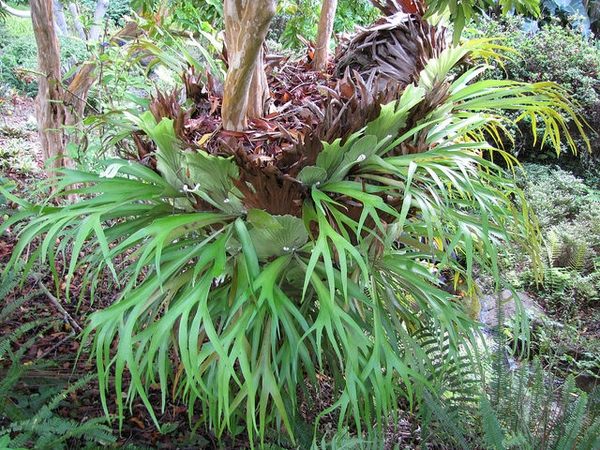
Staghorn fern Platycerium bifurcatum
Staghorn fern (Platycerium bifurcatum) likes bright filtered light. Water every 7 days, every 14 days in winter (November to February). Soak the mount, then let it dry slightly. 18–27 °C, high humidity with airflow. Brown shield fronds are normal.
At a glance
| Scientific name | Platycerium bifurcatum |
|---|---|
| Light | Bright filtered light |
| Water | Soak the mount, then let it dry slightly |
| Water | every 7 days, every 14 days in winter (November to February) |
| Feed | every 30 days, from April to September |
| Growth time | Slow grower |
| Group | Prayer plants & ferns |
Care step by step
How to look after Staghorn fern, task by task: how often, how to do it, the signs it needs it and one thing to avoid.
Water
How often: every 7 days, every 14 days in winter (November to February)
- Feel 2–3 cm down into what it grows in (or lift it: light means dry). Water only when it is dry.
- Water slowly all over until a little runs out of the bottom (a kokedama or a mounted plant: soak it for 10 minutes).
- Let it drain and empty the saucer after 15 minutes, so the roots never sit in water.
Signs it needs it: The top is dry and lighter in colour. The pot feels light when you lift it. Leaves droop a little and perk up after watering.
Avoid: Watering on a schedule while it is still wet: soggy roots rot.
Water · In moss or perlite
- Squeeze a pinch of the moss: it should feel like a wrung-out sponge.
- Water gently all over until it is evenly moist.
- Let the extra drain away; never leave it soggy.
Avoid: Letting it dry out completely: cuttings in moss need steady moisture.
Water · A kokedama or a mounted plant
- Lift it: a light ball or board means it is dry.
- Soak it in a bowl of room-temperature water for 10 minutes.
- Let it drip dry before you hang it back.
Avoid: Hanging it back dripping: it stains walls and rots the moss.
Water · An air plant
- Soak the whole plant in room-temperature water for 20–30 minutes.
- Shake it gently.
- Dry it upside down in bright light for a few hours.
Avoid: Putting it back wet: water left in its centre rots it.
Feed
How often: every 30 days, from April to September
- Water first if it is dry: never feed a thirsty plant.
- Mix the fertiliser at half the strength on the bottle.
- Water it in like a normal watering.
Signs it needs it: Spring and summer, while it puts out new growth. Pale new leaves or slow growth. It has been in the same medium for months.
Avoid: Feeding in winter or right after a repot: a fresh mix has food already.
Feed · In LECA or pon
- Use a nutrient made for hydro or semi-hydro.
- Mix it into the water at the strength on the label.
- Top up the reservoir with it, up to its line.
Avoid: Ordinary soil fertiliser: it builds a crust on the balls.
Feed · A cutting in water
- A cutting needs almost nothing: skip it until it roots.
- Once it has roots, add one drop of liquid fertiliser to the glass.
- Change the water as usual next time.
Avoid: A full dose in a glass: it burns the new roots.
Feed · Kokedama, mounted and air plants
- Mix the fertiliser at a quarter of the strength on the bottle.
- Mist it over the leaves (or add it to the soaking water).
- Do it in the morning, so the leaves dry by evening.
Avoid: A full-strength dose: leaves take it in fast and burn.
Questions growers ask
How often should you water Staghorn fern?
About every 7 days, every 14 days in winter (November to February). Soak the mount, then let it dry slightly.
How much light does Staghorn fern need?
Bright filtered light.
When should you feed Staghorn fern?
Feed every 30 days, from April to September.
What is the key care tip for Staghorn fern?
18–27 °C, high humidity with airflow. Brown shield fronds are normal.
About this plant
Forked, grey-green fronds that branch like a deer’s antlers, growing out of a round shield clasped to a board or tree: the staghorn fern comes from eastern Australia, New Guinea and nearby islands, where it lives on tree trunks without soil. It makes two kinds of fronds: the flat shield fronds grip the mount and turn brown and papery with age, which is normal, while the antlers carry brown, fuzzy spore patches on their tips. Do not wipe the fronds, since the fine white hairs on them help protect the plant. Mounted plants are easiest to water by soaking the whole board in a bucket. Side pups can be cut off and mounted. It is non-toxic to cats and dogs.
Varieties
- Standard
Also called: קרן הצבי
PlantXHub care guide · Last updated: