Peacock plant Goeppertia makoyana
Peacock plant (Goeppertia makoyana) likes dappled or bright filtered light. Water every 5 days, every 8 days in winter (November to February). Moist, drained mix; use low-mineral water. 18–24 °C, humidity around 60%. Keep away from cold drafts.
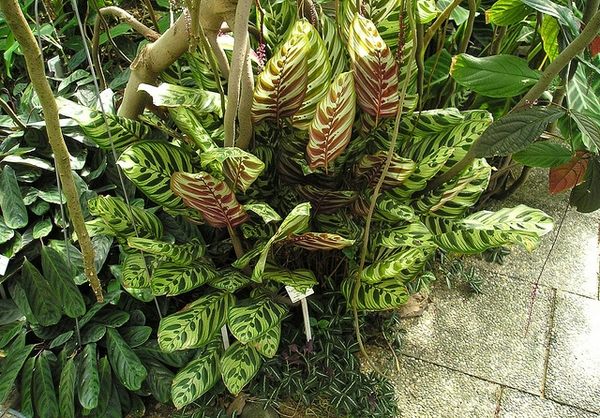
At a glance
| Scientific name | Goeppertia makoyana |
|---|---|
| Light | Dappled or bright filtered light |
| Water | Moist, drained mix; use low-mineral water |
| Water | every 5 days, every 8 days in winter (November to February) |
| Repot | every 545 days |
| Feed | every 30 days, from March to October |
| Growth time | Steady grower |
| Group | Prayer plants & ferns |
Care step by step
How to look after Peacock plant, task by task: how often, how to do it, the signs it needs it and one thing to avoid.
Water
How often: every 5 days, every 8 days in winter (November to February)
- Feel 2–3 cm down into what it grows in (or lift it: light means dry). Water only when it is dry.
- Water slowly all over until a little runs out of the bottom (a kokedama or a mounted plant: soak it for 10 minutes).
- Let it drain and empty the saucer after 15 minutes, so the roots never sit in water.
Signs it needs it: The top is dry and lighter in colour. The pot feels light when you lift it. Leaves droop a little and perk up after watering.
Avoid: Watering on a schedule while it is still wet: soggy roots rot.
Water · In moss or perlite
- Squeeze a pinch of the moss: it should feel like a wrung-out sponge.
- Water gently all over until it is evenly moist.
- Let the extra drain away; never leave it soggy.
Avoid: Letting it dry out completely: cuttings in moss need steady moisture.
Water · A kokedama or a mounted plant
- Lift it: a light ball or board means it is dry.
- Soak it in a bowl of room-temperature water for 10 minutes.
- Let it drip dry before you hang it back.
Avoid: Hanging it back dripping: it stains walls and rots the moss.
Water · An air plant
- Soak the whole plant in room-temperature water for 20–30 minutes.
- Shake it gently.
- Dry it upside down in bright light for a few hours.
Avoid: Putting it back wet: water left in its centre rots it.
Repot
How often: every 545 days
- Water the day before, so the root ball slides out whole.
- Ease it out, loosen circling roots, cut off any brown, mushy ones.
- Set it in a pot one size up (2–4 cm wider) on fresh mix, at the same depth.
- Fill around it, press lightly, water well.
Signs it needs it: Roots come out of the drainage holes or circle the pot. Water runs straight through, or the soil stays soggy and smells sour. It tips over or stopped growing in season.
Avoid: A pot much bigger than the roots: the extra soil stays wet.
Repot · In LECA or pon
- Lift it out and rinse the old balls off the roots.
- Trim any brown, soft roots with clean scissors.
- Set it in a pot one size up and fill around it with clean, rinsed balls.
- Top up the reservoir to its line.
Avoid: Mixing in soil: it stays wet and rots the roots.
Repot · From water to a first pot
- Wait for roots 3–5 cm long, with small side roots.
- Fill a small pot with moist, light mix.
- Make a hole, set the roots in without bending them, firm the mix around.
- Keep it moist for the first week: its roots are used to water.
Avoid: A big pot for a first pot: a small one dries out evenly.
Repot · In moss or perlite
- Ease it out and tease the old moss or perlite from the roots.
- Choose: fresh moss or perlite, or soil if it is well rooted.
- Set it in a pot one size up and fill around it.
- Water it in and keep it out of strong sun for a few days.
Avoid: Packing the moss tight: the roots need air.
Repot · A kokedama: rewrap
- Soak the ball for 10 minutes, then unwind the string.
- Peel off the old moss and keep the root ball whole.
- Add a layer of fresh soil and wrap it in fresh moss, a size bigger.
- Tie it round with string, criss-cross, and soak it again.
Avoid: Wrapping it too tight: water cannot soak in.
Feed
How often: every 30 days, from March to October
- Water first if it is dry: never feed a thirsty plant.
- Mix the fertiliser at half the strength on the bottle.
- Water it in like a normal watering.
Signs it needs it: Spring and summer, while it puts out new growth. Pale new leaves or slow growth. It has been in the same medium for months.
Avoid: Feeding in winter or right after a repot: a fresh mix has food already.
Feed · In LECA or pon
- Use a nutrient made for hydro or semi-hydro.
- Mix it into the water at the strength on the label.
- Top up the reservoir with it, up to its line.
Avoid: Ordinary soil fertiliser: it builds a crust on the balls.
Feed · A cutting in water
- A cutting needs almost nothing: skip it until it roots.
- Once it has roots, add one drop of liquid fertiliser to the glass.
- Change the water as usual next time.
Avoid: A full dose in a glass: it burns the new roots.
Feed · Kokedama, mounted and air plants
- Mix the fertiliser at a quarter of the strength on the bottle.
- Mist it over the leaves (or add it to the soaking water).
- Do it in the morning, so the leaves dry by evening.
Avoid: A full-strength dose: leaves take it in fast and burn.
Questions growers ask
How often should you water Peacock plant?
About every 5 days, every 8 days in winter (November to February). Moist, drained mix; use low-mineral water.
How much light does Peacock plant need?
Dappled or bright filtered light.
When should you feed Peacock plant?
Feed every 30 days, from March to October.
What is the key care tip for Peacock plant?
18–24 °C, humidity around 60%. Keep away from cold drafts.
About this plant
Thin, pale leaves marked with dark green ovals along the veins, like the eyes on a peacock’s tail, with the pattern repeated in purple underneath: the peacock plant comes from the rainforests of eastern Brazil. The species name honours Makoy, a 19th-century plant nursery in Liège, Belgium. Its leaves are so thin that light shining through them shows the pattern from both sides, which looks best when it sits where it gets backlight. Like its relatives it folds its leaves up at night. It dislikes hard tap water and dry air, so use filtered water and keep it away from AC vents. Divide clumps when repotting. It is non-toxic to cats and dogs.
Varieties
- Standard
Also called: קלתאה מקויאנה
PlantXHub care guide · Last updated: